




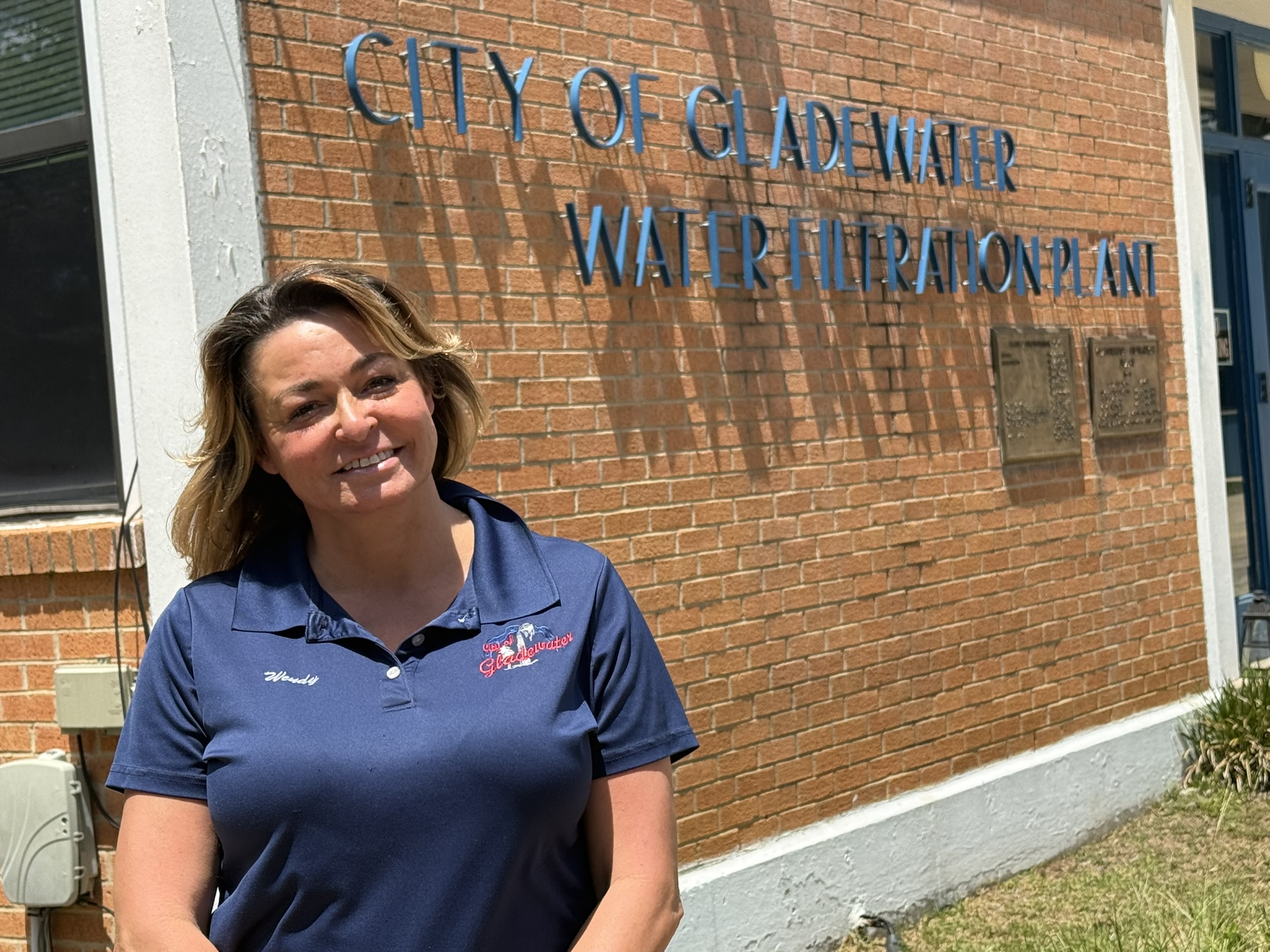
“Care and communication” is making a substantial difference in Gladewater’s total water loss numbers, says Water Plant Manager Wendy Emmel.
Every gallon of treated water costs the community, and every gallon that’s not ‘sold’ is literally money down the drain.
The City of Gladewater’s teams in the Water Treatment Plant and Public Works Department have been tightening the flow, plugging the leaks and putting in extra hours to cut losses and keep the local operation running smoothly.
According to the city’s most recent ‘Water Loss Reduction Report,’ combined efforts by Water Plant Manager Wendy Emmel’s team and Public Works Director Brian Smith’s crew all but halved distribution system losses between 2025 and 2026. Comparing the first six months of the year to the same period in 2025, total losses were tightened by about 58.8 million gallons.
Meanwhile, total system losses – from raw water intake to customer billing – decreased by approximately 41.5 million gallons, a 24 percent reduction.
At the same time, “Customer billed consumption remained essentially unchanged, indicating that the improvement resulted from recovering non-revenue water rather than reduced customer demand.”
What’s it add up to?
“That’s a lot,” Gladewater City Manager Charlie Smith said, simply.
It’s a substantial, strategic change from increasing losses the past six years.
According to this month’s report, from 2020 through 2025 the City of Gladewater’s water accountability data showed a steady increase in non-revenue water – treated water that went unused, wasted in some way, be it leaks, overflow or other factors.
“Every gallon of treated water lost through distribution system leaks has already incurred production costs,” ranging from initial pumping to coagulants, disinfection chemicals, electricity, laboratory testing, operator labor, equipment maintenance and chemical feed equipment operation. “Consequently, increasing water loss results in higher production costs without generating additional revenue. Reducing non-revenue water improves both operational efficiency and long-term financial sustainability.”

Gladewater Public Works Director Brian Smith and his crew members are focused on fixing leaks quickly and fully, yielding steady results in cutting water losses and unnecessary costs.
See the data and learn more from the complete report online at GladewaterMirror.com
“Historical records indicate that deferred maintenance within the distribution system allowed numerous water main leaks to remain active for extended periods,” per July’s reduction report. “As treated water escaped from the system before reaching customers, non-revenue water steadily increased despite relatively stable billed consumption.
“Unaccounted-for water increased from approximately 55.6 million gallons in 2020 to 212.9 million gallons in 2025 representing nearly a four-fold increase over five years.”
City of Gladewater’s employees implemented a variety of operational improvements, from timely maintenance to better coordination between departments, to manifest this year’s progress.
“Continued investment in leak detection, infrastructure maintenance, and interdepartmental communication will further improve system reliability, conserve treated drinking water, reduce operating costs, and enhance long-term sustainability for the City of Gladewater.”
It boils downtown to teamwork and leadership, Smith said.
“The main thing is better management. That’s the big part right there,” he said. “When Wendy came along, we started fixing stuff, number one. A lot of things got fixed out there at the plant.
“The chemical percentages got adjusted, and we were treating what we needed. There was no waste out there.”
Simultaneously, Brian Smith and his Public Works operation were on top of Gladewater’s aging infrastructure with rapid response and repair.
“We’re fixing it right and not having to go back and re-do,” the city manager said. “That’s helping a lot.”
 Key Performance Indicators
for Water Loss Reduction
• 47% reduction in distribution system water loss
• 24% reduction in total system water loss
• 58.8 million gallons reduction in distribution losses
• 41.5 million gallons reduction in total losses
• Customer consumption remained relatively stable
• Improved communication between departments
• Faster leak identification and repair response